Wednesday, April 16, 2014

International incidents and divine appointments

The border crossing to Equatorial Guinea is just a few hundred yards away and Gabon’s is three kilometers in the opposite direction.  On Monday it was decided that as a team we would go into Guinea and walk to the first city.  Turns out, contrary to supposed intergovernmental agreement, the border is ‘closed’ because of economic tensions.  (I can only relate what I’m told, much of what I think is conjecture.)  ‘However, maybe our host pastor* can use his status to speak with the officials, and for a little money we will be able to cross.’  The border crossing consists of a hut on either side of a small river with one of those barriers in the middle that can be manually raised and lowered to allow vehicles to pass.  Okay, two of those barriers, one for each country.  And it’s not really a river, but since it’s been raining heavy most days, and that is the low spot there is water flowing there – about twenty feet across and nearly a foot deep in the middle.  About 50 yards back on the Cameroonian side are boards stretched across the road with nails driven through which can be pulled out of the way for permitted vehicles (or driven around), but will slow assaulting forces if necessary.  There were a couple of enterprising young men there who for a few francs would give piggyback rides across the water for the rare few who wouldn’t wade themselves.  They were also willing to pass the tires and other car parts, baskets of fruit, speakers, and other items which appeared to have free access, even when their bearers didn’t.  We waited several minutes while the pastor first checked with the Cameroonian officials (no uniforms or obvious identification), then waded to the other side to check with the Guineans (who wore uniforms).  He returned awhile later to say that the rest of the group could pass, but no Americans.  Okay, we’ll walk to Gabon, but not before we create a stir.  While waiting Beth had asked if she could take pictures, to which the obvious answer was ‘no, wait ‘til we are away from the crossing’.  (If it’s worth having, it’s worth asking for…)  So, when we had moved beyond those assault slowing devices, she was told it would be okay to take pictures.  Out came the camera, and out came the police and other ‘officials’, and the crowd of onlookers.  After several apologies, yelling, pleas of discretion and empathy, and proof there were no pictures remaining on the camera, an international incident was avoided.  Our walk to, and border crossing into Gabon was without incident, and really rather boring.  Of course we were much more discreet with the camera.  After several minutes we returned to Cameroon and our home away from home, away from home, away from home, away from home.
*The pastor of the church who is hosting us on church property has run this church into the ground and is hoping that we can influence people to come back or bring new people.  The theology and leadership are big problems, and since we are non-denominational and don’t represent any church, we are put in an odd position.  Beth and I think that a big part of why we are here is that Jonas, through his many discussions with him, may have an influence on the pastor which may bring restoration.  Meanwhile our ministry has begun…

We are going out in teams of two or three and making contact with local residents.  Some of which we are introduced to, and others we’ve met on our own.  Yesterday we were brought to the home of a young couple that another team had met the day before.  The woman had seen us in church and asked that Beth, Rebecca, and I (Rebecca left for Garoua this morning) come to meet with her husband, as she felt that we would better be able to relate.  After several minutes of witnessing, mostly by Rebecca in French, he accepted Jesus as his savior.  Later Beth and I questioned the whole experience, wondering things like; ‘could be that simple, would God work like that in America, or was he just responding to get us out of his home.’  We returned this morning for a follow up and heard a testimony that sounded like a script for an interesting movie:  Gang activity, armed robbery, betrayal, bribery of officials, stowing away on a ship to a foreign country, drug running, arrest and imprisonment, and more.  It ended with “I said if God brings missionaries to me who do not represent a church tomorrow, I will know it is God speaking to me.”  No, he was not trying to get us out of his home (in fact ‘the door is open to us any time’), and it can be that simple, and God can do that anywhere.  He is good, and His plans look a lot better than mine.
in Gabon

overlooking our compound.  Church is on the right, our quarters hehind, and Guinea beyond.

bridge over the river separating Guinea and Gabon

inside of the church...

... what the pastor thinks of himself

Thursday, April 10, 2014

Our home away from home

So far not a lot of outreach ministry going on.  Many of the plans have fallen through and expectations on many levels have not been met, but it seems we'll take a little different direction beginning tomorrow.  It's still difficult for us culturally because we are much more task and outcome oriented, so for us it feels like a lot of sitting and doing nothing.  I'm sure we're learning things from that as well, though.
Thought I'd upload a few pics of our living arrangements though...
Adding a string and a wall hook to minimize contact w/the board that covers the 'hole'.

Rebecca buying some delicious dried fish at the local market.  (She had a two week holiday so is here w/us for the first part of  outreach.)

Keeping toilet paper at the ready, not enhancing her bust.  Our room is the door that Samson is in front of.  The one over Beth's right shoulder is used by a couple w/a 2 week old sick baby.  To the left of that is the room J and R started in, but couldn't stand the 'bathroom' smell any longer...

The room where the boys were sleeping until Jonas and Rebecca took over.

The shower.  Bring your bucket...

The door on the left was previously our meeting room/kitchen, but is now where the boys our staying.  We've cleaned up what was previously a church and it now serves as our kitchen/meeting area


the market
Sampson in front of the 'new kitchen/meeting room.  The addition to his left is the shower, the 'WC' is behind it.

Monday, April 7, 2014

Ici 3 morts

So we’ve spent most of the day cleaning, after getting supplies from town.  Some of which were a couple of outlets, lights, and switches which Jonas installed this afternoon.  This compound, and several others, apparently, are served by a generator for several hours a day, and we’re hoping it’s enough to charge things when needed.
As previously stated we are in Kye ossi, which is on the southern border where Gabon and Guinea meet Cameroon.  We could walk into Guinea w/in a few minutes (to the border crossing anyway, it’s to be seen what the actual process is), and Gabon is also just a few kilometers away.  We are on the rough side of town; high unemployment, alcohol and drug addiction, prostitution, and other crimes.  We are staying in a compound owned by a church, and I’m not sure what the surrounding resident’s situation is.  There are ten of us plus a couple in one of the rooms sharing a well, a 4” hole in the floor for a toilet, and the shower; a small space with a 2” hole to the same pit where we take our buckets to splash clean.  There is no kitchen, so meals will be prepped and eaten in a room which serves as a classroom.  The place has been mostly unused for the last several years and wasn’t much to begin with.  Like most African’s live, probably. 
Yes, getting here was a 36 hour process:  Up early in Garoua then a 4-1/2 bus ride on a 70 passenger bus.  There were actually 70 seats and that’s what they sell tickets for, so except for the unpaid children, everyone had a seat.  Everyone’s luggage also fits in the designated compartments or overhead racks, no rooftop luggage racks on the big bus.  (Once again, Beth and I are over packed, but we didn’t carry near as much as most people.  But, we’re not moving like most of them probably are, and we don’t need to carry all our worldly possessions.)  The bus was not in great condition, and the road was a variety of potholed pavement, new construction, or a combination, but it was generally uneventful.  There was quite a climb to Ngaoundere, and from there the climate and scenery has been significantly different.
After arriving N’ere, we had a six hour wait for the train’s departure.  Rebecca and the rest of the team visited her father who suffered a heart attack and stroke two years ago, while Jonas and I waited for the train terminal to open so we could move the luggage inside.  The train ride was 16 hours over night arriving Yaounde around 10:30 am.  Beth and I rode a sleeper car, Jonas and Rebecca were in first class, and the boys rode in second class.  We are the privileged, after all.  Like the bus before it, the train was dirty and in rough condition, but it was interesting.  Since there were only berths in our compartment we decided to sit in the ‘restaurant’ car for the first few hours.  Problem here is most of the seats at the tables are sold as regular seats, and only a few were for the dining customers of the first class and sleeping car customers.  Some interesting exchanges taking place there.  Of course when we returned in the morning, all of those had sleeping passengers as well.  Yaounde could be Douala, could be Kampala, could be Nairobe, could be any large African city that I can tell.  Chaos.
The last leg was really the most interesting.  First a taxi from the train station to a section of the city where all the bus operators are.  Five of us, our luggage, and the driver in an old Toyota hatchback sedan.  Five is okay most of the time, but for the last 100 yards Rebecca got to walk after paying the ‘surcharge’ for an overloaded vehicle.  Then it was buy tickets and get loaded into the ’19 place’ van.  Get in your seat early so you can have it when they actually depart.  Which in this case was about 45 minutes later, because there were only 18 of us beside the driver, and they desperately wanted to sell that last ‘place’.  (Though I still don’t know where it is.)  Then to the gas station for just enough fuel to get to Kye ossi (never fill the tank), then back to the operation base because the driver realized he didn’t have money for tolls.  Then get out of traffic and onto the highway south.  Luckily we got around the accident between the full size bus and taxi before the traffic jam really got bad.
It wasn’t long before we hit the open road which was generally in pretty good shape and uncrowded.  The driver seemed to want to make good time and the van had the power to do it because we passed several vehicles along the way and quite frequently exceeded 120 km/h.  (That 60 km/h that’s painted on the back of all the taxi vans apparently is some sort of guideline, or is there to impress potential customers.)  We probably would have made it in record time except those darn police check points along the way.  Ten of them.  They check everyone’s government issued ID card, or passport and there seems to be no logic to their location.  Jonas had a document listing all of us, and our reason for travelling, but he had to explain himself and provide all of the ID’s each time, often having to “go inside’ for further explanation.  There was also a DRC refugee on board who was questioned at each checkpoint except for the last one.  That’s because he was detained at the one before, and by this time the driver was so frustrated he wouldn’t wait any more.  Somehow the guy beat us to our final destination and was waiting to get his stuff off the top of the van when we arrived.  It was hot and crowded and what was supposed to be a four hour ride turned into six.  But we made it.  These can be frustrating experiences, but as I sit there cramped and sweaty I remind myself that this is the way of life here.  They put up with it every day, and I try to remind myself of it.
I made some vehicular observations that we selfish Americans should learn from:
Full sets of lugnuts are for aesthetic purposes only.  If you should happen to have a full set, that means you’ve got at least one spare.
Matching tires are also just an aesthetic thing.
We replace our tires much too soon.  Treads really aren’t important.  I’ve seen racecars and they don’t run with them.  In these hot temperatures, and under the loads they operate there’s plenty of traction.
Starters aren’t really necessary.  There’s always enough manpower for a pushstart.
Seat belts should only be available to drivers.  Because when a vehicle is correctly loaded people will act as human air bags or roll cages in an accident.  

We’re so snotty.
(The title of this post translates as 'here 3 deaths'.  Common roadside signs posted by the government to remind people to drive carefully.)
on the bus.  leather seats... 
our berth on the train

that's a goat on the top of this taxi.  seems cruel, but probably the best spot to be...


stop along the way to pick up another

We've moved

Sorry about not updating lately.  We are in Kye ossi (kee-oh-see) for the first part of our outreach phase.  We have no power or plumbing, very different than what we've been accustomed to.  Not a mud hut, but much more typical of African living arrangements.  There will be many stories and pictures to follow, I hope, but until we have opportunities to charge all the devices it will have to wait.  The journey here itself could take several blogs:  Bus from Garoua to Ngaoundere, train from Ngaoundere to Yaounde, '19 place' taxi van from Yaounde to here.  Thirty six hours total.  Climate is more comfortable, similar to american south, and much greener.   God is with us, and we are praying for continued grace...

Sunday, March 30, 2014

road trip

We took a road trip this week; to the town of Kaele about three hours away by bus.  We went for a church leadership seminar with over 500 registered attendees, and I was one of the speakers.  Here's how that came to be:
3-1/2 weeks ago, Jonas:  "There is a church leaders seminar in a town north of here, they would like one of the students to speak, can you do it?"
Me: "Yeah, or maybe one of the others..."
Jonas:  "They would like someone from outside of Africa"
Two days later:  Jonas:  "Okay, you are speaking,  your topic; 'hope for leaders', 20 to 25 minutes, it's time for class."
A few days later:  Jonas:  "You are on the schedule for all three days, let's eat."
Some things get lost in translation.
I guess it went okay, I wasn't one of the featured speakers, but I started each day with a short message, and they let me come back the second and third days.  The audience was almost entirely French and native speakers, so I'm not sure how it was received after translation...
The perks:  A hotel room for Beth and I, with A/C, and meals with the other speakers.  We also got to ride in a car for the first time since the US, about a half mile from the hotel to the venue (3 times), and to a private home for dinner one evening.  Unfortunately the A/C wasn't working the first night, and at about 2am the unit blew up.  Fortunately someone was there to throw the breaker, because they had heard and smelled that it was having problems, and had already been messing with it.  We were put in another room the next day and that A/C worked.  The rooms themselves were not like American hotel rooms.  I'll leave it at that.
Having been in this one place the entire time, I'd formed a picture of how Cameroonians live.  Wrong picture.  Nearly as soon as we left Garoua it became rural and we saw how most of North Cameroonians are living;  in small villages or compounds of mud brick huts with thatched roofs, and no electricity or running water.  With the exception of three towns we passed through where there was a mixture of those homes and those of more 'solid' construction.  In or near some of the villages we saw bore holes (wells with hand pumps), in others I didn't see a source of water.  But we crossed over four dry, sandy river beds where holes had been dug to the water which were surrounded by people doing their laundry, bathing, and carrying it away.  The terrain was interesting, generally flat, but lots of small rocky hills or mountains.  Vegetation was scrubby small trees with occasional larger as well.
The bus ride was typical for Africa I think.  Crowded with lots of stuff tied on top.  Not too bad going up.  Early in the day with a window that opened.  Coming back was mid afternoon and the window we were next to wouldn't open.  As soon as the bus moves everyone closes their windows.  Go figure?  When I first saw the buses, I could see 19 seat backs and thought 'this should be okay'.  Then I saw '30 places' painted on the side.  Not sure the total going up, probably 30ish, but I counted 34 adults, two children, and one chicken.  We also stopped for a half hour so the muslim driver could pray, and another time to replace a blown tire.  There was also a police check point where we waited while ours and Oliver and Abel's (Congolese) passports were checked.  The bus ride(s) to outreach next weekend total about 24 hours....
It's still the dry season, but there was a thunderstorm with rain while in Kaele, and it actually rained a good amount here this morning.  Thunderstorm last night and this morning with heavy rain and comfortable cool temperatures.  Hot again now, though, and more humid with the wet ground.  Jonas said in the seven years he's been here, he's never seen rain.  Beth has been praying for rain, and so have many of you.  Thank you.


Sunday, March 23, 2014

If it's broke, don't fix it

More about the water situation:  It’s on overnight and a few hours in the afternoon.  The pressure isn’t very good most of the time.  There is an outdoor spigot where we fill buckets and bottles, there is the kitchen sink, and there are the bathrooms.  If any one is running, there’s usually not enough pressure to get anything from the others.  The whole community is putting demand on the system, so there’s not enough to go around.  However we’ve found that if you get up in the middle of the night or very early in the morning you can get more than the drip that is usual for the shower at other times.  So we’ve started trying to do that, or catch it in the middle of the day while the others are napping and before it gets cut off.  Twice Beth has been in the middle of washing her hair when that’s happened.  There have been other frustrations as well.  Related is the toilet situation which until now I’ve hesitated to talk about because, well, it’s a toilet situation…
I think I mentioned earlier the students all share one shower, Jonas and his family have their own bathroom and the other toilet is for students.  Jonas has a policy that if there are women present only they get to use the toilet, or in our case, so can the husband.  We don’t necessarily agree, but our protests were only half hearted, since we benefit.  There are probably very few Africans who haven’t squatted over a hole, but if a toilet is available that’s where they want to go.  When it was announced that this was the policy it certainly didn’t raise our popularity amongst some already suspicious students.  It doesn’t help that the toilet is at the end of the hall next to their rooms, and the door makes a lot of noise (and sometimes we do too).  Nor would anyone choose to squat over a hole in the concrete in a corner formed by two cinder block walls without any cover.  It’s in the sun the entire day, so I’m sure the temperature easily exceeds 120 on most days, and I don’t think the rainy season offers much relief either.  (Is that a pun?)
The toilet supply line has leaked when the water is on since we’ve been here, but over the last several days it had gotten significantly worse, so I decided to attempt repairs.  Using scraps of inner tube rubber I’d picked up for just such a situation I fashioned gaskets for either side of the supply valve which is attached directly to the tank.  The first time there seemed to be some improvement, but I wanted to try again.  That was worse, so I decided to give it one more try.  Of course I’m making these attempts while the water is off, then waiting for sufficient pressure to see if it’s made a difference.  Sometimes when we know the water is on there and all the other valves are closed there’s still not enough pressure to get to the shower head or fill the toilet tank.  Such was the case last night when we went to bed at 10:30.  And for the second time we decided to sleep on the porch where it’s a little cooler, as Jonas’ family has been doing for several nights.  Jonas left yesterday for the weekend, but Rebecca and the kids were set up on the porch as well.
You’ve probably figured where this is going by now, and you were right.  I got up around 1: 45, and as I entered the house I could hear it:  spraying water. The threads of the valve had actually been corroded and cracked, and with the increased pressure they let go.  The toilet room and half the hallway were under water to the door of Rebecca and Jonas’ room.  Surprise, the floor isn’t level, so the water hadn’t flowed into the boy’s rooms which would have been closer.  So I cut off the water and got to work with a squeegee, pushing, pulling, and splashing it over the tile lip into the shower area.  After about an hour it appeared I had it all, and nobody got woke up; including Jean-Mark who was sleeping on the floor where the hallway begins.
In the morning, when Rebecca woke up, I told her what had happened and warned her that some water may have gone under her door.  Welcome to Lake Tjouie (their last name).  Their entire room had standing water, some nearly two inches.  Did I mention the floors aren’t level?  All of their belongings are in that room, so you can imagine what a mess.  We pulled everything outside and had the water squeegeed and toweled pretty quickly.  The soggy boxes of belonging were emptied and spread out to dry, and I think most things survived.  Lots of personal papers and books and stuff, so hopefully what needs to be saved was.
I’ve learned some lessons: 
1.       1 If it’s broke, don’t fix it.  You’ll be suspected of breaking it to begin with, or making it worse.  Okay maybe not, but if I hadn’t messed with it, the valve may have held for several more days or weeks.
2.     2  Young African men sleep well.  Nobody stirred during the entire episode.  I could hear them snoring on the doors and on the floor behind me.

3.    3   The replacement parts and tools that are available are worthless.  (I already knew that, a factor in our call to being here.)  I bought a complete toilet repair kit, a new flexible line, and cutoff valve ($11.25 for all), and the new valve is leaking worse than the old broken one.  It’s  more than a day since I started this, we kept the water shutoff overnight, and I’ve just put the old flexible line back on,  bypassing a valve.  We’ll see tonight if it works.
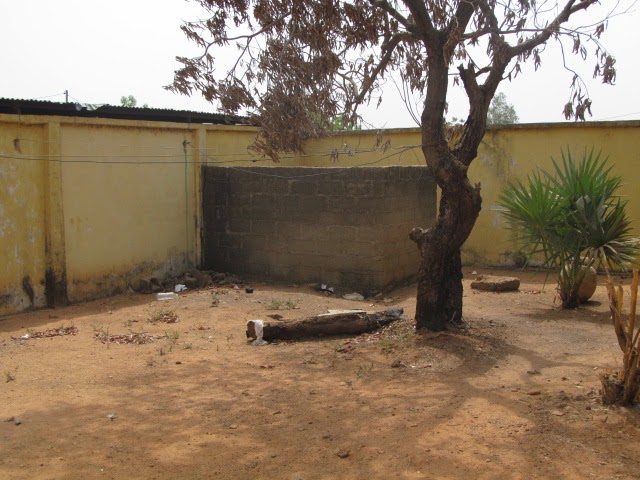
Our room is the first on the left, the boys are the next two, Jonas' is on the right, and the forbidden fruit is behind the door.

the boys bathroom, behind the grey wall
the clothes dryer stretches from the wall on the left to the tree

the outdoor water supply

amongst all the other trash scattered on the ground are these flip flop gasket remains

Another common sight; exposed water pipe.  Light weight poly crossing roads and footpaths.
When they rupture or are cut they become community water supplies until fixed.
Do you think this has anything to do with the water pressure?
At least they're below the frost line.

Thursday, March 20, 2014

Rebecca's day

Rebecca considers herself blessed to have an indoor kitchen.  A kitchen with a sink, a stove and a refrigerator.  She spends much of her day there, and she works magic.
We have three meals each day.  Most days breakfast is simple, a piece of bread per person from the store nearby, and a cup of tea.  Not a lot to it, and it’s usually Jonas and Rebecca or someone else (even I’ve done it), but Rebecca is also usually in there getting something for the kids as well as getting started on lunch, before she has to go to work, or town, or whatever.  Lunch and dinner are usually basic as well, typically a starch and a ‘sauce’, but that doesn’t mean they’re easy.  Her sauces are all made from scratch and include many ingredients; tomatoes, carrots, okra, greens, ginger, onions, garlic, to name a few, and sometimes a few pieces of meat, or fish.  The meat and fish are cooked separately, and require much preparation of their own.  The starch usually consists of rice, sweet potatoes (not like ours, but large and peeled and cut into chunks), spaghetti, plantains, or cous-cous.  Cous-cous is a local staple and can be made a variety of ways, but involves a lot of mixing, cooking, stirring, and shaping.  She will usually make enough ‘sauce’ for lunch and dinner, but it has to be reheated, and she will usually make another starch, or more of what was left from lunch.  She often makes a salad as well, but she insists on making them pretty with grated carrots and cucumbers, sliced tomatoes and onions, and if we’re fortunate avocado or boiled eggs.
Anything that needs to be ground or crushed is done on a flat piece of granite (not cut or polished, naturally broken that way) with another roundish piece of granite.  With the exception of spaghetti, a few packets of tomato paste, and something resembling bullion cubes, nothing comes in packages.  It all must be prepared by hand.  So on market day, when we buy produce, it first must be washed, then picked over, leaves and stems separated, and whatever else.  Most will be further prepped prior to cooking.  Hours will be spent picking over rice and beans to get out the bad ones, sometimes on the day of cooking, or when there’s some spare time.
(As I type this, she’s just got home from work, changed her clothes, and is in the kitchen getting something for her kids.  I think she might take a nap, though.  Lazy.)
A lot of the prep is done while sitting on a bucket with trays or tubs spread around on the floor.  She does have a blender which she will occasionally use to liquefy the vegetables she’s chopped for certain of her recipes.  (She doesn’t use a cook book or recipe cards, everything is in her head.)  The water is all from buckets, because there is no running water during meal prep or cleanup. 
The temperature in the kitchen is always much higher than the rest of the house or outside, and is nearly unbearable for Beth and I.  Even Rebecca complains, and says that on the worst days it’s unbearable for her as well. 
Except those that she does while preparing meals, Rebecca doesn’t do dishes.  It’s one of the work duties assigned to students.  (It’s one of ours…)  Beth and I have helped quite a bit with meals since we’ve been here, but as the heat as affected Beth, it’s happening less. 
Assuming the power stays on, and there is water, and propane, and the refrigerator works (constant battle…), pretty easy life.  This week we’ve run out of propane, and there is none available at any of the stations locally, so it’s back to the outdoor ‘kitchen’ to cook with wood.

In addition to her time spent in the kitchen, there is her children, her job, grading schoolwork, shopping, participating in some our activities, amongst other things. A liberated Cameroonian woman.


crusher/rolling pin

water supply


the backup...