Sunday, March 29, 2015

How's the weather?

When we were home in Colorado I paid too much attention to the weather.  The weather forecasts actually, and the discussions about weather.  I also had the ‘news’ playing on the TV and radio enough to be reminded of how much of the broadcasts are dedicated to weather.  And I allowed myself to be influenced by them, making and changing plans based on the forecasts of cold and snow.  I was again frustrated by how much time and energy we spend on something we really have no control over, and why do we (I) allow it to be the topic of so much of our (my) conversation?  Well it’s not just in the US, it’s here as well.  When we returned it was the beginning of the ‘rainy season’.  But it wasn’t raining.  So many of the conversations were about, or included the need for rain. Even on the drive from the airport; our driver was very soft spoken and hard to understand so we didn’t talk much, but when we did it was about rain.  It also influences the behavior here; preparation for planting, what to plant, where to plant, when to plant, as well as how to navigate the roads.  Well I’m happy to report the rains have (mostly) come, planting is occurring, and navigating is interesting.
a rainy season garden

It’s been relatively quiet since we’ve been back.  There’s not a lot happening with Homes of Hope, the next building team isn’t scheduled to come until August.  Also, I’ve made it known I don’t want to be as heavily involved, so I think that will be respected, but for now I’ll be part of the planning and logistics until roles are more defined.  Which is the reason for weekly meetings which happen on Mondays: except when they don’t, because some or all of those scheduled to be there don’t show up; as was the case last week.  The next order of business is to get feedback at an all staff meeting (Wednesdays), and maybe get a clearer idea of the way forward for Homes of Hope at Hopeland.  We’ve also begun weekly meetings (Tuesdays) to work on establishing the Men’s Vocational School which is where my heart is.  It’s been said that YWAM may stand for youth with a meeting; which may be based in reality, but if it results in action that’s okay.
 
The last week Beth and I were pretty sick, and for Beth a trip to the hospital was in order as she became very dehydrated.  (First we had to navigate the road from the base which was ‘suffering’ from the first rains, and required maneuvering around a mired bus.) There are many ‘clinics’ and several ‘hospitals’ to choose from; we chose the brand new Nile International Hospital.  It is run by Turkish doctors, is very modern and boasts four floors with an elevator, and several departments including; L&D, radiology (with a CT scanner), emergency, a surgery theatre, pharmacy, and even a cafeteria.  We’re still in Africa, but it really was impressive.  I think most clinics use a dart board to diagnose (“You don’t need stitches, you have malaria.”), but I’m pretty sure this place uses a modern Wheel of Tropical Diseases which they spin to get their diagnoses.  Actually the consulting physician suspected Typhoid which was ‘confirmed’ by the blood and stool samples taken and analyzed in the lab.  Beth then spent several hours in an ER bed receiving IV fluids and medicine, after which we were sent home with a round of antibiotic and two additional meds.  The total cost for the doctor’s consultation, lab work, in patient care with IV fluids and meds, and prescriptions from the pharmacy was 75,000 Ugs, about $23.  (At that rate we can afford to drop our health insurance, right?) Though we’re pretty sure we didn’t have Typhoid, we do suspect a water or food borne illness, as several others here have had similar symptoms.  We hope we won’t be needing medical services again, but should the need arise we would return to that hospital to take another chance on the Wheel of Tropical Diseases.


Sunday, March 15, 2015

Missionaries

Used t’be I coont even spell it, now I are one!

As a child, up to the age of about 13, I attended Catholic church and Catechism with my mother and brothers and sisters, and I remember hearing a lot about missionaries.  I was also raised in California, and the fourth grade curriculum included California history which was full of information about Father Juanipero Serra who established missions along the California coast.  (We got to build sugar cube models of some of those missions, and even took a field trip to visit one.)  I’m sure it was in that context that I formed my perceptions about what a missionary is.  I had, and still have, to some extent, this vision of priests and nuns going into unchurched native cultures and converting the population.  That was accompanied by then ‘civilizing’ that population; meaning forcing them to give up their native beliefs and practices, put on clothes, adopt western ways, and be ‘Christian’.  My early days in the evangelical Christian community did little to change my perception of what a missionary is, except now in my mind a missionary didn’t wear frocks and collars or a habit, but rather they were a conservatively dressed white family who were civilizing the natives.  Because of this perception, for most of my life I’ve struggled with the term ‘missionary’.  Yet now, as it comes up in conversation, we refer to ourselves (and others do, as well) as ‘missionaries’.  Not because we feel like we’re missionaries in what our traditional perception of what that means, but really because it’s easier.  Rather than try to explain why we are in Africa and what we’re doing, it’s easier to say ‘we’re missionaries’.

But aren’t we all missionaries?  Whether it’s actively or passively, we’re all representing someone or something we believe in.  And by our words and actions we demonstrate our allegiances.  You won’t find the word ‘missionary’ in the Bible, but you can find ‘ambassador’.  It’s actually the word I prefer for what we’re doing here, Beth and I are ambassadors of what we believe in.  As Christians, we’re all certainly called to be Christ’s ambassadors, wherever we’re at.  For some it means ‘going out on the mission field’, the way we’ve been taught to believe (like going to Uganda or some other foreign place, wow), but I believe your mission field is wherever you’re at.  I know that what we’re doing here is what we are supposed to do, but it’s no more important than what anyone who is following Christ is doing.  It’s easy and tempting to say ‘I’m a missionary in Africa’ (maybe even impressive to some), but really we’re only doing what we know we are supposed to do.

Sometimes we hear how what we’re doing must be ‘so difficult; missionaries, in Africa!’  I probably haven’t done much to dispel that, but it’s just not true.  First, when you’re doing what you’re supposed to, God is not going to let it be too difficult.  That said, life here (for us) is not difficult anyway. Often frustrating, inconvenient at times, even mystifying sometimes (“really?”…), but overall pretty simple.  Uganda, and Jinja in particular, is easy.  Jinja is home to hundreds of missionary and humanitarian organizations, which means a large western presence, which results in a cottage industry catering to the westerners.  Restaurants, supermarkets, recreation, tours, and etc, are all available. And while Beth and I try to integrate ourselves with the local population, we certainly take advantage of those things.  On the YWAM base itself we have all the comforts of home. (They’re just not very comfortable, or well done. Actually what I’m hoping to change as part of my ‘calling’.)  What we’re doing is not for everyone, but it is for us, and it’s not hard.

Which is why, as of yesterday, we are back in Uganda.  After a great visit ‘home’ we’re back to a much quieter base than when we left.  The VTS girls are gone on holiday before going to their internships, the performing arts DTS is away on outreach, and there are no visiting teams.  On Monday we’ll get back into our routines (or maybe start new ones), but the weekend is for getting over jet lag, and reconnecting.


Thanks for all who made our visit home special.  It was great spending time with the family and friends we were able to, and apologies to those we missed.  The generous hospitality and sharing of time and resources we received is greatly appreciated.  The perks of being missionaries…
Suffering through another missionary meal  (At one of the restaurants we frequent in town) while playing peek-a-boo with a child at another table.

Thursday, February 5, 2015

January

It’s already February.  Time flies when you’re having fun, or at least when you’re staying busy, which we have been.  Homes of Hope still consumes the majority of my time, and Beth continues to be involved in many of the happenings on and around the base.  By using a standard of ‘at the end of the day, point to what you have accomplished’ our productivity sometimes might be considered low, but sometimes the work we do can’t be measured in tangible units.  There are many things which impede ‘work’ here, and as someone who values work and productivity, it can be extremely frustrating.  But hopefully I can learn from them, use them as teaching opportunities, exercise patience, and sometimes help to change them, if appropriate. 
There was a DTS team here at the beginning of January from Tijuana (YWAM Baja/San Diego), the home base of Homes of Hope, who were here to ‘build’ the home for which we had prepared the foundation.  In my opinion, things didn’t go well.  ‘We’ didn’t have all of the materials and tools needed, there wasn’t reliable transportation, and things got rushed.  But at the end of their allotted eight days of building time the walls were up and (mostly) plastered and painted, part of the roof was on, a door and shutters were hung (so they could get their pictures) and they prepared to leave with the feeling of a job well done.  Some of the team leader’s last words as they gathered for the pictures and ‘presentation ceremony’ were: “Don’t worry, they’ll finish tomorrow” pointing to me and the two ‘students’ I’ve been working with.  ‘Tomorrow’ was nearly four weeks ago and we’re getting close to finishing.  And ‘finished’ is another relative term.  We hope to be to the point where the family can move in to the home in the next few days, and I suppose that’s what we’re calling finished.
This whole project has certainly given me plenty to think about.  It’s the subject of many discussions, especially between Beth and me.  There are many philosophical considerations, and of course the practical implications.  I’m not going to try to spell all of those things out here, but here are a few:  Is it ‘right’ to give a home to someone?  Should there be conditions?  What is the impact within their community?  What technologies and materials should be used?  Should it be done by outsiders?  What about follow up?  I know a lot of people participate in ‘short term’ mission trips, often for building projects (I have), these are things I think should be discussed as part of the preparation for those trips.  I’m still trying to sort out many of these things myself, meanwhile there are more teams scheduled to come to build more homes (of hope).
Meanwhile we get involved with other things.  Beth has gone with visiting teams as they go to minister at different places.  She also went one weekend to Soroti, about four hours away on a bus, where she visited Amachek; a home for children with AIDS and other serious diseases whose families can’t care for them.  This week she went to a village clinic primarily providing pre and post natal care to women.  Beth also spends a lot of time with the girls who are here for vocational training.  There are ten of them, mostly from difficult backgrounds, and they really value the ‘family’ time Beth and others spend with them.  We really enjoy getting to know them and being a part of their lives as well.
Next week we’ll be going home for a few weeks visit.  I’m not looking forward to Colorado’s weather, but of course we’re excited to see family and friends.  No offense to anyone else, but Lucy sits at the top of the list of those we’ll spend time with.  I think I’ll even be able to work on our taxes with her around…

We’ve already purchased our return flights (really affordable, this time), and I’m already anticipating our time back here.  I feel like we’re leaving many things undone, and I have plenty of ideas about things I want to do when we get back.  In spite of the many frustrations, this is where we belong for now, so even though we look forward to the break, it won’t be too difficult coming back.  We’ve got a growing shopping list of things to bring back as well.  Things we want to have for our ‘home sweet home’ away from ‘home sweet home’.


The 'finished' home the team left...
...with much left to do.  


With some of the VTS chefs

Saturday, December 27, 2014

Wedding, HoH, Christmas

It’s been a long time since the last post.  It feels like we’ve been busy, because we have, but it’s hard to say what has been accomplished in that time.  I think it is part of our western culture; we’re goal oriented, and we set about our tasks with specific objectives in mind.  I’m that way to a fault, often at the expense of my relationships.  That’s not the way things are here; between Africa time, lack of resources, lack of motivation, relationships, and distractions; we can feel busy, but outcomes are different.  That said, here’s some of what has been happening in our lives.
The beginning of The Introduction.  Bride and her attendants are huddled together, plenty of speeches to follow...

The wedding is about to begin.

After the washout at the introduction, bride and groom meeting remaining guests.

Building a foundation and 'pouring the slab'.  Use those hammers to make big rocks smaller.
  Kitchen and existing home are behind.


Boy: "Can we burn the ends of your hair?"
Girl:  "It doesn't work with their hair."

Christmas dinner.

We attended our first Introduction and wedding.  There is a couple here on the base, he Canadian and she Ugandan, who were married two weeks ago.  She is from western Uganda, so that’s where the ceremonies were held.  The Introduction is a big deal and is more traditional, while the wedding is important, but has become more ‘westernized’.  We left here at four in the morning for the seven hour drive (three small rental cars, five people in each, no more comfortable than the other modes of transport…) to the bride’s hometown so that we could get there in time to clean up before the introduction which was to start at one(ish).  The introduction ceremony was held at her parents’ cattle farm which is very nice and scenic.  There were over 1000 people there, including friends, family, and nearly everyone from the local village.  It was a catered event (as was the wedding reception), so first everyone was fed; buffet style and quite the spread.  (Apparently in this part of Uganda the food comes after the ceremony, but there it was the other way around.)  Once everyone had eaten and was seated the introduction begins:  There is an emcee (I’ve learned that microphones and PA systems are well liked here) who speaks continuously as the families, special guests, us included, and the groom come ‘in’ and take their seats.  Finally the bride and her escorts, all covered to disguise their identities, are ushered to a mattress in the center of the crowd where they squat down and will remain for most of the rest  of the ceremony.  The groom is then presented with traditional gifts, which of course are explained as they are presented, and then the ‘speeches’ begin.  The speeches are given by family members, pastors, friends, that guy in the market that may have seen the bride or groom one time, and seemingly anyone who might have something nice to say, hand them the microphone.  I’m not sure when they were going to end, but after 2-1/2 hours the sky opened up with a deluge, and that was the end of the ceremony.  There was supposed to be some fanfare of the groom trying to pick his bride from amongst the covered bridal party, but instead everyone scattered into the rainstorm, and the gifts and other things that could be gathered into cover were.  When we tell people who weren’t there the ceremony was cut short by a rainstorm, without exception the response has been: ‘That is a blessing’.  I take it to mean the speeches probably would have continued indefinitely, but some say the rain is a good omen for the marriage.

The next day was the wedding which was to start at ‘midday’ in the church.  Some said midday was around twelve, others closer to one.  I’m still not sure, but when we arrived around 12:15 the church wasn’t very full, but there was an emcee trying to fill the time with explanations of what was happening and what would happen.  And at 12:50 the bride and groom were standing together ‘at the altar’ before the preacher.  It was a very typical wedding, except that anyone with a cellphone or camera was welcome to photograph every aspect of the event and were continually around the couple, getting between them and the preacher and the ‘official’ photographer and videographer.  The reception was held at a hotel about five miles away, and we rushed there right after the wedding since our driver was the emcee and wanted to be there before the guests and wedding party arrived.  It wasn’t really necessary though, since the reception wasn’t done being set up, and it was about three hours before the emcee was needed.  More speeches, the children’s choir singing and dancing, gift presentation, etc.  We eventually got on the road about 7:30 for the long drive home.
I’ve still been busy with Homes of Hope, much of the last ten days ‘helping with’ the foundation and slab for the home a team from the US will be building next week.  We don’t do ‘em like this in the states.  Let’s just say ‘work smarter not harder’ wasn’t in play on this job, and it’s a good thing this isn’t going to be a complex house it’s not going to be subject to a lot of stresses.  Also be thankful for delivery of proper materials and concrete, because that doesn’t happen here.
 
This was our first Christmas abroad and the first without any family.  The climate and environment don’t really set the ‘Christmas mood’, but through the efforts of some people on base, it was actually very nice.  On Christmas eve we visited one family’s home for tea and snacks, then later another’s for more refreshment, and then that evening there was a bonfire, caroling and sharing of scripture with several families represented.  We started Christmas day with calls to our children and Lucy.  Later we had lunch with a Ugandan family, then went to another home for dinner.  Those hosts, a Canadian couple who are running a school here, outdid themselves for all of us (another couple and a couple of students and staff from their school).  Stuffed chicken, veggies, mashed potatoes, and several desserts, all served with special attention and cheer.  It was a very nice day with barely enough time to miss home.


Most of the base is ‘shut down’ for the holidays, which means normal activities are suspended, but there are still some schools running and plenty of people who didn’t leave, so it’s quiet but not dead.  I’m still busy preparing for the HoH build, as well as other projects and repairs that come up.  Beth has spent several afternoons watching movies with the kids on base, and has kept busy with other things as well.  We are learning we don’t need to constantly push to get things done, but it’s hard to change a lifetime of habit and culture.  Change comes slowly…

Thursday, December 4, 2014

Forward steps, backward steps

The more you see, the more you know.   As we spend our time here, we’re seeing and hearing more and more about YWAM, the base, and its operation.  It’s not Utopia (darn), and the challenges and frustrations are probably more than we anticipated, so we try to remind ourselves of why we are here and move on.

It’s a big base, with lots of big plans and ideas (vision), but not enough resources and manpower to follow through.  Not enough, really, to maintain what’s already here, so it seems to be the source of a good deal of frustration.  Of course, there are plenty of opinions about what could and should be done, including my own.  But it also presents opportunity for positive change, and I think that’s what Beth and I get to be a part of.  It also means that the men’s vocational training school and health clinic aren’t immediate realities, the resources just aren’t available for either and it wouldn’t be wise to start another project which can’t be done well.  I believe we’ll see those things at some point, but for now we are filling other roles.  The biggest is building relationship; with staff and students and others we meet and interact with.

One of the successful programs here is a girl’s vocational school.  Most of the girls come from backgrounds which would make it very difficult to finish their education or develop useful skills which would allow them to become self-sufficient.  Many are orphans, or have had to drop out of school, or lived in situations which put them at risk for failure.  They come here to live for a year while learning skills; hospitality, cooking and baking, and others, as well as participating in the base community. We (primarily Beth) are building rapport and spending much time with the girls.  It’s part of the mentoring role which we play and is really the bigger reason for being here.

The most time consuming thing for me has been to try to keep the Homes of Hope block production going.  Unfortunately it’s not been very successful.  Equipment breakdowns, power failures, having to relocate have all interrupted what we’re trying to accomplish.  Basically we’re trying to make giant legos from expanding foam (the kind you seal gaps with).  It requires a consistent high amperage electrical supply for the air compressor and heating elements, specific chemicals for cleaning the equipment, and a clean and organized work area.  None of which are available here, so we try to make due.  We’ve now set up in a chicken coop, but because of breakdowns haven’t got much done in the last two weeks.  It’s obviously not the appropriate technology right now, but since there is a group coming in two weeks to build a home, and the equipment and chemicals are here we’re going to follow through with production for now, and re-evaluate whether to continue the process once the remaining 55 gallon barrels of chemical are gone.

Between the times spent on that I’ve taken on the task of trying to clean and organize some of the storerooms on base.  I’d done one when we had to relocate the HoH operation, and unfortunately it became the catchall for that.  There seems to be a tendency to throw things which are broken or not known what they are, or for, into locked spaces where they get buried and become home for rats, mice, wasps and other critters.  Anything of value or usefulness disappears because of a lack of accountability or knowledge of what’s there.  It’s our hope to restore those things.  Meanwhile I get to go on treasure hunts, and have already used many things to improvise on other projects.

Last week the School of Sustainable Agriculture that was here finished up.  Since the leaders and four of the students were American, and because graduation coincided with Thanksgiving, they decided to treat the base to a Thanksgiving feast; complete with green beans, mashed potatoes and gravy, pumpkin pie, some local dishes, and beef.  (Turkey and chicken were too expensive.) The girl’s vocational school did all the cooking and serving, and it was excellent, and everyone really enjoyed the evening, including the music and dancing after the graduation ceremony and meal.

This week we’ve moved into what should be our more permanent home.  We’ve taken over the space previously occupied by the Ag school leaders, and prior to that another couple close to our age.  It’s basically a one bedroom apartment with a small kitchen and (terribly executed) bathroom.  The other couples have done a good job of stocking it with kitchen supplies and a few furnishings, so we have only a few things to do to make it ‘home’.  Both the other couples have tentative plans to return, so it will be interesting to see how we’re all situated if we’re here together.
"That is a snake!"  (almost as big as the spiders)

some Thanksgiving desserts

some Thanksgiving caterers- vocational school girls

Homes of hope block making arrangement.  Chickens on the other side of the screen aren't happy.


One night in the other place I found a snake in the kitchen.  It was small, maybe sixteen inches, dark in color, and kind of pretty, but we didn’t know what kind it was.  Rather than kill it, I caught it in a bucket to let go because I prefer harmless snakes to mice and some of the other critters that snakes eat.  There were some people in a common room next door and Beth went over to ask if anyone could identify the snake we’d caught in our room.  One young man said he knew about snakes and came over to help us out.  When he came over and looked in the bucket he declared:  “That is a snake!”  We’ve met a lot of people, and I don’t know all their names yet, but I’m calling that man Sherlock.

Monday, November 17, 2014

Homes of Hope

 It’s been a busier week.  There is a YWAM ministry based out of Tijuana called Homes of Hope.  Their mission is to build homes for the poor; efficiently using cost effective technology, and locally available materials and labor.  One of the technologies they’ve been using is foam building blocks encased in plaster and concrete.  Last year they shipped most of the equipment needed to make the foam blocks here, and then built a home in Kakira (see last blog).  Dr. Tim, the Hopeland director, has a vision to build several homes in the area, including a long range vision of building an entire community and sees Homes of Hope as a logical fit in that vision.  Last year HoH shipped molds, other equipment, chemicals, and many other materials for producing the foam blocks.  They also sent a couple of guys to set things up, and later a team to build the home.  They’ve also purchased many tools and materials here, and have trained a few young men in the process.  Two guys from HoH have been here for the last week to try to get it going again in anticipation of building more homes beginning next month.  There have been a lot of problems with the equipment and very few blocks have been made so far, but it seems most of the kinks have been worked out and there may be better results moving forward.  Since I’ll be working with young men to develop vocational skills, I will be heavily involved in this project.
setting up for block building

celebrating....


Beth has had a busy week as well.  One day she attended a meeting in town to meet with several medical professionals from various organizations which have different ministries in the area.  She met another nurse there who was able to spend a day with Beth giving a crash course in HIV/AIDS, and its treatment methods here in Uganda.  On Friday she was planning to go to visit Musana and some of the people there, but first she and some of the other ladies on base met with the Women with Hope group.  Turns out one of those women had died, so the whole group walked to her home in a nearby village for the pre-funeral viewing.  Beth and one of the other women here have also begun an early morning exercise routine twice a week which they are hoping others will join.  She also was asked to administer IV drugs to one of the vocational school girls who had been to a clinic in town, and diagnosed with a serious infection for which she had been given several meds.  Beth and I have also been asked to take on a kind of mentoring and parenting role to the vocational school girls, which is something Beth had been feeling called to already.  When we move into our ‘permanent’ quarters it will be near where the vocational girls are housed.

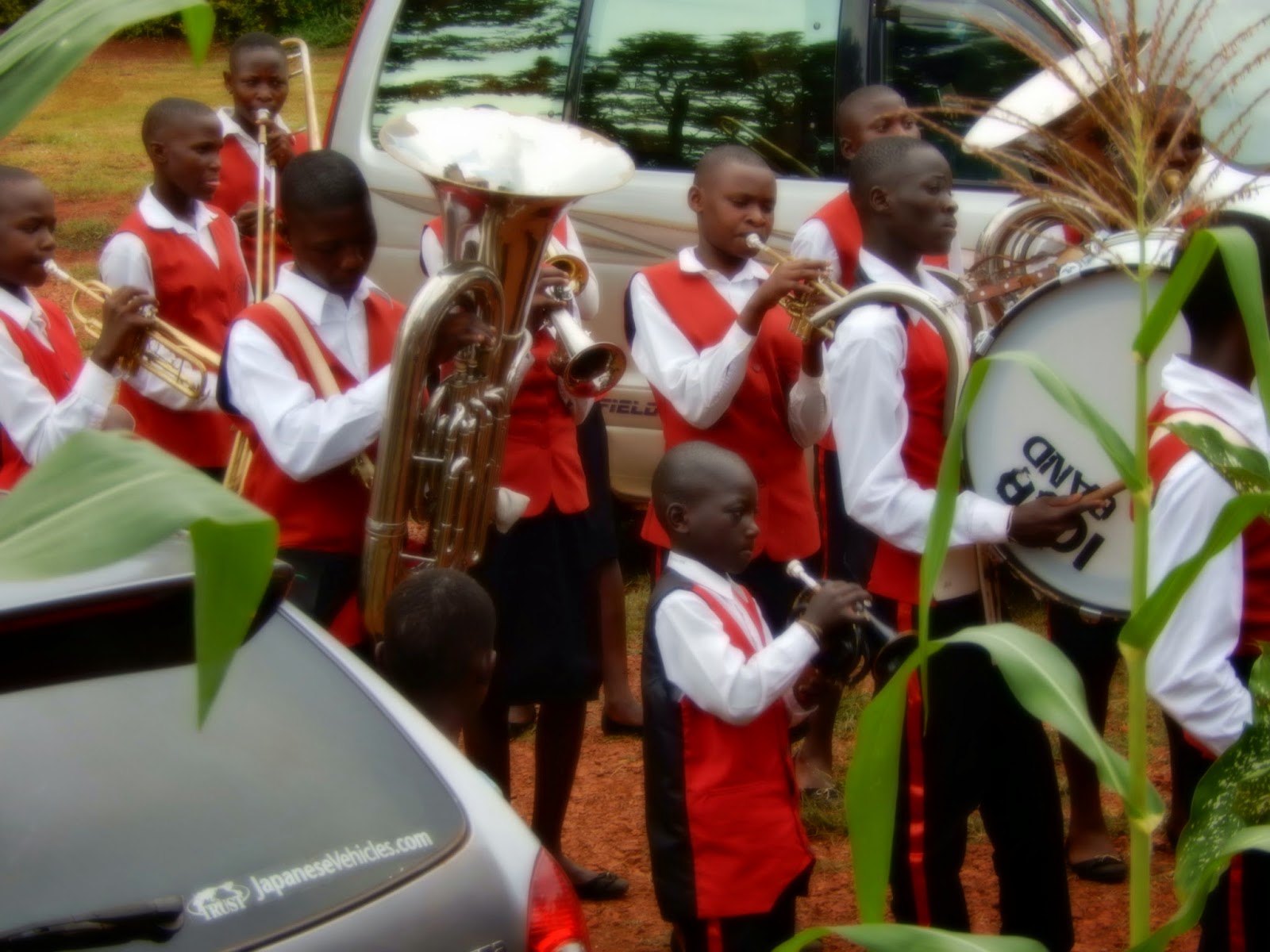
On Saturday there was a big celebration on base.  One of the staff members and her husband are celebrating their 25th anniversary, and that’s a big deal here.  It started with a special service at their church, then a parade through town, followed by a procession to the base.  There was a marching band, much pomp and circumstance, speeches, dance performances, bubbles, gift giving, and a feast.  There were hundreds of people in attendance, typical I understand, for such events.

This base is very peaceful and somewhat secluded, but we have been warned last time here and this, that it’s not safe to be out after dark.  There have been rapes, murders, and robberies are common.  We’ve also been warned to always lock our room because ‘even though YWAM people are mostly honest, there are a lot of people who move around on and through the base’.  It’s okay though, because the base is mostly fenced, and there are large gates at the two road accesses, one of which is guarded most of the time.  Of course we noticed that one of those gates and much of the surrounding fence was missing when we got here this time.  Also, when we returned to the base one evening at about nine, it took several honks from the boda driver to wake up the guard to unlock the remaining gate and let us in.  I guess we could have walked the hundred yards or so, to where the other gate had previously been.  Before it was stolen…


Sunday, November 9, 2014

stories

 Everybody has a story, right?  As you get to know people you begin to learn their stories; some will tell you directly, others you learn by circumstances and observations.  Yours, mine, theirs; they are constantly being written, and told, and interpreted.  We’re seeing and hearing some of those stories:

Nancy is a 58 year old widow from Kenya who is a student in the Discipleship Training School.  Like us, she is not your typical DTS student, she is in a class with mostly twenty-somethings with an entirely different outlook on life.  But she has wisdom, and faith unlike any one I’ve met.  She lost her husband twenty years ago, and in her culture that is a terrible thing.  Without a husband ‘a woman is nothing’, disdained by nearly everyone, including his and her own family.  She wanted to die, but God showed up.  He is her source; father, friend, provider, everything and everyone to her.  Her confidence and poise are amazing and inspiring.  We are excited to hear how God uses her during the DTS’s upcoming outreach.

George is a 36 year old student in one of the other schools here.  Orphaned and sent to live with uncles at age four, and put out on the streets at six.  He ate from rubbish piles and survived the streets.  He was taken in for part of his childhood by a widow who ensured he attended school where he completed part of his primary education.  As a teenager he joined the Ugandan military to ‘fight for my country’ against Joseph Koni’s forces who were terrorizing his part of the country.  Afterword he returned to his ‘home’ on the streets.  He then spent nine years as a fisherman on Lake Victoria before meeting Jesus.  His life was transformed, including deliverance from a twenty year opium habit.  He has nothing, but finds himself here preparing for the fulfillment of his dream of a ministry for Ugandan street kids.

Julius and Mary are on staff over the girl’s vocational school, and they are who we will be primarily working with for the boy’s vocational school.  They have four children, two at home, and two in boarding school.  Julius’ father suffered a stroke last year and lives with them here on the base.  Last weekend Julius’ brother was hit by a car while on his way to work and left for dead on the side of the road.  A passer-by found him, and he was somehow transported to the hospital in Kampala.  Broken pelvis, broken arm, crushed facial bones, and internal injuries.  One surgery so far and another scheduled for tomorrow.  (If the $180 can be found to pay for it.)  Julius has been staying with him in the hospital, and Mary can’t leave the house because of her father-in-law’s condition.  Financially, Julius and Mary are eking by, and this ‘run of bad luck’ hasn’t helped matters, but by their faith and positive attitudes you’d hardly know it.

Of course there are others…

On Friday Beth and I went to a nearby small town, Kakira, to buy bananas for the Women With Hope meeting that was to be held later that afternoon, and to buy g-nuts, raw shelled peanuts for someone who asked us to do so.  We found the market which is mostly empty during the week, but we did find a young boy selling bananas from a tray on his head.  We made him wide eyed and happy when we bought his entire stock, but we still needed to buy g-nuts and asked him where to find them.  He didn’t understand English though, but an older boy nearby seemed to.  He talked to the younger boy, and we understood that we were to follow the younger to a place to get the nuts.  Single file, we left the market, then the town itself, and weaved our way through a ‘residential’ area; mud houses, garden plots, chickens, goats, cows, and lots of kids.  It was apparent we weren’t going to be buying from a typical vendor, and Beth asked if the kid (who kept looking back at us) understood, or we should turn back, but I figured we were being taken to ‘an inside source’.  After several minutes we arrived at a place where the boy’s grandmother (I presume) stood talking to two other bewildered women sitting in their doorways and staring at the Mzungus who had followed the boy home.  The grandmother took the banana money, and between the three women we were able to determine they did not have g-nuts there.  We gave the boy a small tip, said our thank-yous and goodbyes, and made our way back to the market.  There we found a pair of women sitting on a mat shelling peanuts.  The peanuts were not ready to be sold, and the women didn’t speak English either, but one was able to understand what we wanted.  She took Beth’s hand and guided us to a stall where she woke up a man who then sold us some g-nuts.

Beth wants to take some Luganda lessons.  Perhaps we should.
a view from a boda
not what you want your driver to be doing

searching for g-nuts